
Poweshiek County Court Records After Arrest
The local criminal case path is described by the Poweshiek County Attorney criminal process page. A reported crime is investigated by the agency with jurisdiction, and charges may be filed when an officer has enough evidence to believe a specific person committed an offense. In Poweshiek County, the court record starts with the charging paper filed with the Clerk of Court, not with a jail roster screen. A jail arrest can happen first, but the public court record is where the complaint, case number, hearings, bail terms, charge amendments, plea, trial activity, dismissal, or sentence are tracked.
The custody side and the court side answer different questions. Current jail custody, booking status, and release routing belong with the sheriff and the Poweshiek County jail inmate records workflow. Booking photos, when releasable, belong with the Poweshiek County jail mugshots workflow. Court records after a jail arrest focus on the case that follows the arrest: what was filed, whether a bond was set, whether a warrant remains active, and how the charge ended.
The official local source shows a path from investigation to complaint, initial appearance, bail, preliminary hearing, Trial Information, arraignment, motions, plea negotiation, trial, sentencing, and post-sentence custody. A county jail sentence may include work release. A prison sentence shifts custody from the sheriff to the Iowa Department of Corrections, so court records explain the judgment while the DOC locator explains later prison or supervision status.
Find Poweshiek County Court Records
Use Iowa Courts Online for public trial court lookup after a Poweshiek County jail arrest. The official Iowa Courts Online help material says the public portal is not the official court record, but it can display case titles, filings, party and lawyer names, criminal charges, disposition entries, fines, fees, and payment data where public access is allowed. Some electronic documents may require a courthouse public terminal or a paid subscription. Juvenile and confidential cases are not shown in ordinary public search.
The Poweshiek County Clerk of Court is at 302 East Main Street, P.O. Box 218, Montezuma, IA 50171. The current court contact page lists phone 641-212-4232, fax 641-222-1205, and email countyclerk.poweshiek@iowacourts.gov. Use the clerk for docket questions, hearing confirmation, public terminal access, and official record issues. Use the sheriff for present jail custody.
- Confirm current custody with the sheriff if the arrest is very recent, because a booking can exist before court entry.
- Search Iowa Courts Online by defendant name, date of birth, citation number, or case ID when available.
- Select Poweshiek County for a local criminal case if the portal asks for county or case location.
- Open the case and read each charge, filing date, hearing entry, bond condition, and disposition line.
- If no case appears, try fewer name characters, alternate spelling, and later search timing before calling the clerk.
The official help guide notes that case data appears one business day after court entry and then updates in real time. A same-day arrest may not be searchable yet. A person may also be held for another county, a state probation or parole issue, a federal process, or an immigration matter, so the absence of a Poweshiek County case does not always mean no custody event occurred.
Poweshiek County Court Search Fields
The public court search has several paths. A name search is broad, a date-of-birth search is more exact, and a case ID search is best when the number is known. The official search guide warns users to remove extra spaces, use capital letters in case IDs, and remember that zero and the letter O are not the same. Partial names and wildcard characters can help when spelling is uncertain.
| Search mode | Field | Required | Use note |
|---|---|---|---|
| Name search | Last or firm name | Yes | At least two letters are required. |
| Name search | First name | No | An initial may be used without a period. |
| DOB search | Date of birth | Yes | Exact date of birth is required. |
| DOB search | First and last name | Yes | The last name cannot be wildcarded. |
| Case ID search | County, case type, case ID | County and type | Choose Poweshiek for local cases. |
| Citation search | Citation number | Yes | Useful for traffic or citation-based charges. |
The Iowa Courts Online landing page is a good match for the court-record stage after arrest.
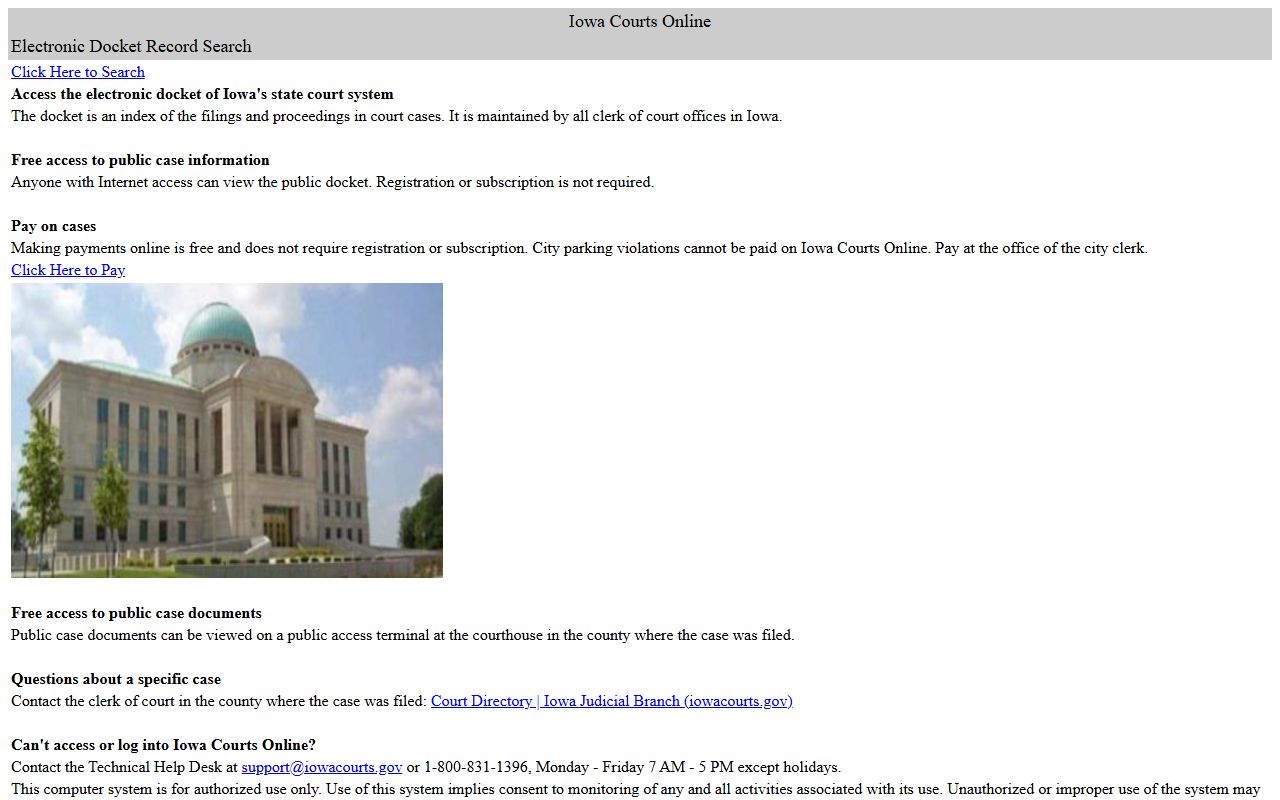
The portal is statewide, so Poweshiek County selection, case type, name spelling, and case ID format matter when the arrest happened locally.
Poweshiek County Arrest Charge Documents
The local prosecutor is the Poweshiek County Attorney's Office, not a district attorney office. County Attorney Bart Klaver and Assistant County Attorney Alexander Sandeen are listed by the county attorney page, and the office says it prosecutes state-law violations in Poweshiek County, reviews criminal-law violations for prosecution, and handles juvenile delinquency matters. The county attorney does not investigate crimes, prepare private legal papers, or give private legal advice.
The charging paper tells more than the first arrest label. A complaint may start the case after an officer has enough evidence. A preliminary hearing tests probable cause, although the local criminal-process page says that hearing is rarely held because the same purpose is usually served by filing a Trial Information. A Trial Information is the charging document that contains the indictment and Minutes of Testimony, and arraignment is the formal accusation and plea stage.
| Document | Who uses it | What it means after arrest |
|---|---|---|
| Complaint | Officer or prosecutor with filing through the clerk | Starts many cases when evidence supports a specific charge. |
| Trial Information | County attorney, reviewed by a district judge | Often replaces the preliminary-hearing function and contains the indictment with Minutes of Testimony. |
| Indictment | Included in the Trial Information context locally | States the formal accusation that moves the case toward arraignment. |
Poweshiek County Charge Status Records
Charges can change after a jail arrest. The first booking reason may be broad, incomplete, or based on what the arresting officer knew at the time. The filed court record may use different wording, add counts, reduce counts, dismiss counts, or show a plea to a different offense. A charge is an accusation. A conviction is the result of a guilty plea, verdict, or other finding that supports judgment.
| Status | Meaning in the court record |
|---|---|
| Pending | The charge is open and no final disposition is shown. |
| Amended | The filed charge text or level changed after filing. |
| Reduced | The charge moved to a lower offense level or lesser count. |
| Dismissed | The charge was ended by court action, prosecutor action, or another legal reason. |
| Disposed | The court record shows an outcome, such as plea, verdict, sentence, or dismissal. |
| Charge | Conviction | |
|---|---|---|
| Stage | Filed accusation after arrest or summons | Final result based on plea, verdict, or judgment |
| Custody impact | May affect bail, holds, and hearing schedule | May lead to jail, prison, probation, fines, or other sentence terms |
| Where to verify | Iowa Courts Online, clerk, and filed documents | Court disposition, judgment entry, and later DOC status if prison is ordered |
The county attorney criminal-process page shows the local arrest-to-case sequence used for filed charges.
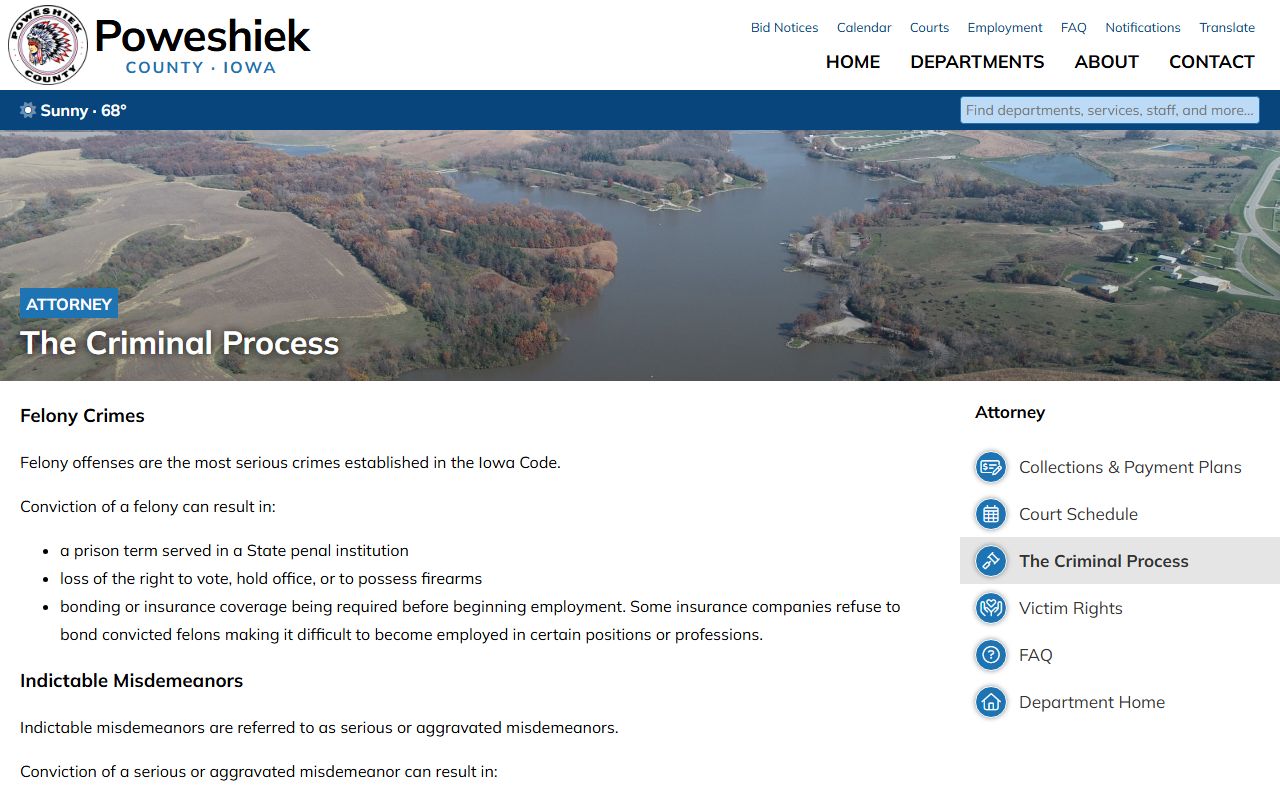
The local process source is useful because it separates investigation, complaint filing, initial appearance, bail, Trial Information, arraignment, and sentence outcomes.
Bond Records After Poweshiek Arrest
Bail conditions are set at initial appearance. The Poweshiek County Attorney criminal-process page says an initial appearance is set shortly after arrest, and at that hearing the magistrate advises the defendant of charges and possible legal consequences, counsel rights, preliminary-hearing date, no-contact order if applicable, and bail conditions. The local court schedule page says Wednesday includes Magistrate Court and initial appearances, but hearing times should be confirmed with the clerk.
Iowa Code Chapter 811 governs bail and release. A bailable defendant is generally released on personal recognizance or unsecured appearance bond unless the magistrate finds that will not reasonably assure appearance or protect others or the community. Conditions may include supervision, travel or association limits, deposit up to ten percent of bond, surety bond, cash in lieu of bond, or other conditions tied to appearance and safety.
| Release or bond type | How it works in Iowa context |
|---|---|
| Personal recognizance | Release based on a promise to appear when the court finds it adequate. |
| Unsecured appearance bond | A bond obligation that may not require the full amount up front. |
| Cash deposit or cash in lieu | Money posted under court-set terms before release. |
| Surety bond | A surety-backed bond subject to Iowa bail rules. |
| No-bond or hold issue | Release may wait for judicial action, another court, DOC, federal process, or ICE. |
Warrants in Poweshiek Court Records
No official Poweshiek County active-warrant list, warrant search, most-wanted list, or app-only warrant tool was located. Warrant questions after a jail arrest should be routed to the Poweshiek County Sheriff's Office at 641-623-5679 for custody issues and to the clerk for court-case warrant entries. A bench warrant for failure to appear may show in court docket activity, but not every warrant will appear in a public online search.
An arrest warrant authorizes taking a person into custody. A bench warrant is often issued by a judge after a missed court date or a court-order violation. A search warrant allows a search of a place, person, or property and does not always mean the person is in jail. A fugitive warrant or detainer may involve another county, another state, the U.S. Marshals, DOC supervision, or immigration custody.
Important: A posted local bond may not cause release when a separate warrant, detainer, or state or federal hold remains active.
Public Access to Court Arrest Records
Iowa Code Chapter 22 is the public-records law for government records unless an exception applies. It does not create an automatic online portal for every jail or court item. Section 22.3 allows reasonable actual-cost fees for records work. Section 22.7 includes confidential-record exceptions, while section 22.7(9) treats criminal identification files as confidential but says records of current and prior arrests and criminal history data are public records.
The practical result is narrow but useful. Court records after a Poweshiek County jail arrest can usually be searched through Iowa Courts Online after entry, checked with the clerk for official issues, and matched with sheriff custody information when the person may still be in jail. For statewide criminal-history checks, the Iowa DCI criminal-history process is separate and has a $15 per-check fee listed by Iowa.gov.
Restricted records need care. Juvenile cases and confidential case types are not available through ordinary public court search. Medical data, some investigative material, victim-protection records, protected addresses, and some criminal identification material may be withheld or redacted. A public court docket is not a consumer report and should not be used for employment, credit, housing, insurance, or other FCRA-covered decisions.
Sealed and Expunged Iowa Records
Iowa Code Chapter 901C governs expungement for qualifying Iowa records. Section 901C.2 can apply when all charges were acquitted or dismissed, financial obligations are paid, at least 180 days have passed unless waived, and statutory exclusions do not apply. Section 901C.3 addresses certain misdemeanor convictions after more than eight years if the listed conditions are met. Expungement is a court process, not an automatic deletion of every public mention of an arrest.
| Sealed or confidential | Expunged under Chapter 901C | |
|---|---|---|
| Public view | Hidden or limited by rule, order, or case type | Made confidential and exempt from public access when the statute applies |
| Who may still see it | Access depends on the order, statute, and agency role | The defendant and certain agencies or persons may still have access |
| Best route | Ask the clerk what public access limit applies | Use Iowa court forms and the court process for eligible cases |
For a dismissed Poweshiek County charge, read the court disposition first. Then check whether an expungement form or legal motion fits the case. A dismissal entry, by itself, does not prove that all jail, court, criminal-history, or third-party references have become confidential.